
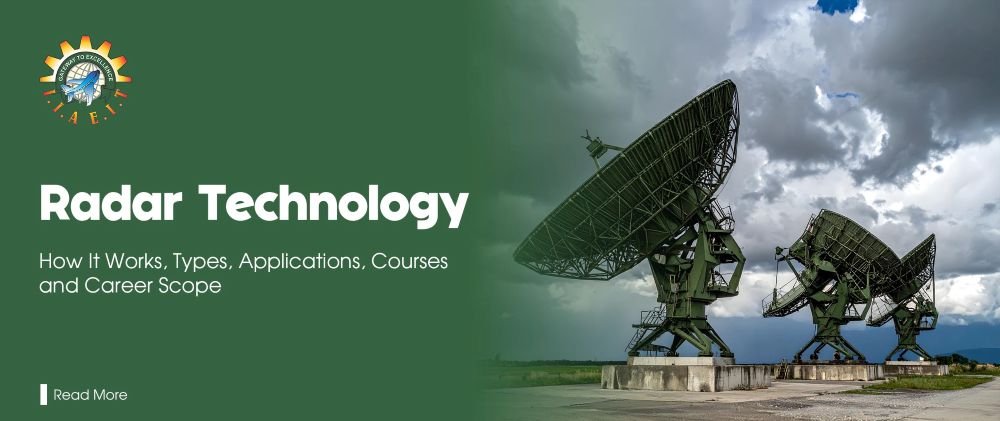
Radar technology is a core sensing technology used to detect, locate, track and analyse objects using radio waves. It plays an important role in aviation, defence, air traffic management, weather monitoring, maritime operations, space systems, automotive applications and surveillance.
Unlike systems that depend on visible light or cameras, radar can operate by transmitting radio-frequency signals and analysing the signals reflected from objects. This makes radar particularly useful when visibility is limited or when continuous information about an object’s position and movement is required.
For students interested in aerospace, avionics, defence technology and electronic systems, understanding radar technology provides a foundation for exploring areas such as sensing systems, navigation, communication, electronic warfare, autonomous platforms and aerospace systems.
What Is Radar Technology?
Radar, short for Radio Detection and Ranging, is a technology that uses radio waves to detect and determine information about objects.
A radar system generally transmits electromagnetic waves into an area and receives the signals reflected by objects within its coverage. By processing the returned signal, the system can determine information such as:
- Distance from the radar
- Direction or bearing
- Relative movement
- Speed
- Position
- In some systems, characteristics of the detected object
The basic principle can be expressed as:
Transmit signal → Signal interacts with object → Echo returns → Radar processes echo → Object information is determined
Radar is therefore both a sensing and measurement technology.
In aerospace and defence, radar can form part of larger integrated systems involving communication, navigation, flight control, surveillance and electronic systems.
Why Is Radar Technology Important?
Radar technology is important because it helps detect and track objects over long distances, even when visibility is limited. Pasted markdown
Its key applications include:
- Aviation: Aircraft detection, tracking and air traffic management.
- Defence: Surveillance, detection, tracking and situational awareness.
- Weather Monitoring: Detecting precipitation and monitoring weather conditions.
- Maritime: Detecting ships, obstacles and navigation hazards.
- Space & Aerospace: Tracking, surveillance and Earth-observation applications.
- Autonomous Systems: Providing environmental information for autonomous platforms.
- Engineering: Combines electronics, electromagnetics, signal processing, computing and aerospace technology.
How Does Radar Technology Work?
The fundamental operation of radar can be understood through five stages.
1. Signal generation: The radar system generates a radio-frequency electromagnetic signal.
2. Signal transmission: An antenna transmits the signal into the surrounding environment.
3. Interaction with an object: When the transmitted electromagnetic wave encounters an object, a portion of the energy is reflected.
4. Echo reception: The reflected signal, or echo, travels back toward the radar and is received by the antenna.
5. Signal processing: The radar processes the received signal to determine information about the detected object.
One of the fundamental measurements is range.
If the transmitted signal travels to an object and the reflected signal returns to the radar, the approximate distance can be calculated from the signal’s travel time:
Range = (Speed of electromagnetic wave × Round-trip time) / 2
The division by two is necessary because the signal travels from the radar to the object and then back again.
How does radar determine movement?
Radar can also determine an object’s relative velocity by analysing changes in the received signal. The Doppler effect is particularly important in radar systems used to measure relative motion.
This principle is widely relevant to applications where identifying whether an object is approaching, moving away or changing speed is important.
Types of Radar Systems
Radar systems can be classified in several ways depending on their operating principle, application, frequency range and method of signal processing.
1. Primary Radar
Primary radar detects objects by transmitting radio waves and analysing the echoes reflected from them.
It does not necessarily require the target to actively transmit information back to the radar.
2. Secondary Radar
Secondary radar systems work through communication between the radar system and a cooperative transponder carried by the aircraft or other platform.
This allows additional information to be exchanged beyond the basic reflected signal.
3. Pulse Radar
Pulse radar transmits electromagnetic energy in short pulses and measures the returning echoes.
The time taken for the echo to return can be used to determine range.
4. Continuous-Wave Radar
Continuous-wave radar continuously transmits a signal. It can be particularly useful for measuring the velocity of moving objects using Doppler frequency shifts.
5. Doppler Radar
Doppler radar uses frequency changes caused by relative motion to determine the velocity of a target.
It is widely associated with applications such as weather monitoring and motion detection.
6. Phased-Array Radar
Phased-array radar uses multiple antenna elements and controls the phase of transmitted signals to steer the radar beam electronically.
This can reduce reliance on mechanically rotating antennas and enables rapid beam steering.
7. Weather Radar
Weather radar is designed to detect precipitation and monitor atmospheric conditions.
It can provide meteorological information useful for tracking rainfall and severe weather systems.
8. Synthetic Aperture Radar
Synthetic Aperture Radar (SAR) uses the movement of a radar platform to create high-resolution images of Earth’s surface.
SAR can be particularly valuable for remote sensing because radar can operate independently of daylight and, depending on the frequency and conditions, can provide observations through cloud cover.
Radar types at a glance
| Radar type | Basic characteristic | Common application area |
| Primary radar | Detects reflected signals | Surveillance and aviation |
| Secondary radar | Uses cooperative transponders | Air traffic systems |
| Pulse radar | Uses transmitted pulses | Range measurement |
| Continuous-wave radar | Continuously transmits | Velocity measurement |
| Doppler radar | Uses Doppler shift | Weather and motion detection |
| Phased-array radar | Electronically steers beams | Defence and surveillance |
| Weather radar | Detects precipitation | Meteorology |
| SAR | Produces radar-based imagery | Remote sensing |
Key Components of a Radar System
Although radar architecture varies according to its application, a radar system generally consists of several major components.
Transmitter
The transmitter generates the radio-frequency signal that will be sent toward the target area.
Antenna
The antenna transmits electromagnetic energy and receives reflected signals.
Some radar systems use separate transmitting and receiving antennas, while others use a shared antenna arrangement.
Receiver
The receiver captures weak reflected signals and converts them into usable electrical information.
Signal processor
The signal processor analyses the received data and extracts information such as range, velocity and target characteristics.
Display or user interface
Processed radar information can be presented to an operator or another system for interpretation and decision-making.
Power supply
Radar systems require an appropriate power system to operate their electronic and RF components.
Control and computing systems
Modern radar systems can incorporate sophisticated computing systems for signal processing, tracking, data fusion and automated analysis.
The integration of these components demonstrates why radar engineering is not limited to a single branch of engineering. It involves electronics, electromagnetics, signal processing, computing, control systems and system engineering.
Applications of Radar Technology
Radar technology has applications across civil, commercial, scientific, aerospace and defence environments.
1. Air Traffic Management
Radar can be used to detect and track aircraft, providing information required for managing aircraft movements.
2. Defence Surveillance
Radar can provide long-range surveillance and tracking capabilities for defence systems.
3. Missile and Weapon Systems
Radar can form part of systems used for target detection, tracking and guidance.
4. Weather Forecasting
Meteorological radar helps detect precipitation and monitor weather systems.
5. Maritime Navigation
Ships use radar to identify surrounding vessels, land features and potential hazards.
6. Space and Earth Observation
Radar technologies are used in remote sensing and certain space-related applications.
7. Automotive Radar
Modern vehicles can use radar sensors for functions such as object detection, adaptive cruise control and collision-warning systems.
8. UAVs and Autonomous Systems
Radar can provide sensing capabilities to unmanned aerial vehicles and autonomous platforms, particularly where robust environmental perception is required.
9. Airport and Aviation Security
Radar and related sensing technologies can support surveillance and monitoring around aviation infrastructure.
10. Research and Scientific Applications
Researchers use radar systems to investigate atmospheric conditions, Earth’s surface, space objects and other physical phenomena.
Advantages and Limitations of Radar Technology
Radar offers several technical advantages, but its performance also depends on system design, operating environment and application.
| Advantages | Limitations |
| Can detect objects over significant distances | Systems can be technically complex |
| Can operate without visible light | Performance can be affected by environmental conditions |
| Can measure range and relative velocity | Signal processing can require substantial computing |
| Useful for tracking moving objects | Radar signals can experience interference |
| Suitable for surveillance applications | System cost can vary considerably |
| Can support all-weather sensing applications | Interpretation can require specialised expertise |
| Can be integrated with other sensing systems | Resolution and detection capability depend on system parameters |
Radar should therefore be viewed as one component within a broader sensing and information system rather than as a universal replacement for other technologies.
Radar Technology Courses in India
Students interested in radar technology should understand that radar is generally studied as part of broader engineering disciplines rather than only through a standalone undergraduate degree titled “Radar Technology.”
Relevant academic pathways can include:
- B.Tech Avionics Engineering
- B.Tech Aerospace Engineering
- B.Tech Aeronautical Engineering
- B.Tech Defence Technology
- Electronics and Communication Engineering
- Electrical and Electronics Engineering
- M.Tech programmes related to avionics, aerospace, electronics or defence technology
- Specialised radar, RF, microwave and signal-processing courses
The most suitable pathway depends on the student’s intended career area.
Radar through Avionics Engineering
Avionics focuses on the electronic systems used in aircraft and spacecraft. These systems include areas such as navigation, communication, flight control, radar and embedded systems. IIAEIT’s B.Tech Avionics Engineering programme specifically identifies radar, navigation, flight control and embedded systems among the areas students study.
Radar through Defence Technology
Students interested in the defence applications of radar can consider a Defence Technology pathway. IIAEIT’s B.Tech Defence Technology programme covers Radar, Communication and Electronic Warfare Systems, along with cybersecurity, autonomous systems and UAV technologies, defence electronics and embedded systems, and space defence and strategic technologies.
Radar through Aerospace Engineering
Aerospace Engineering provides a broader foundation in aircraft and spacecraft systems. IIAEIT’s B.Tech Aerospace Engineering programme covers aerodynamics, propulsion, aerospace structures and materials, flight mechanics and control, and space engineering. The programme also provides practical learning through projects, industrial training and specialised learning.
Students specifically interested in the electronic and sensing side of aerospace systems may therefore find Avionics Engineering or Defence Technology particularly relevant, while Aerospace Engineering provides a broader aircraft-and-spacecraft engineering foundation.
Skills Required to Work in Radar Technology
A career involving radar technology requires a combination of engineering fundamentals, electronics knowledge and analytical capability.
Technical skills
Students can develop knowledge in:
- Electromagnetics
- Radio-frequency engineering
- Antenna systems
- Digital electronics
- Analog electronics
- Signal processing
- Communication systems
- Control systems
- Embedded systems
- Programming
- Data analysis
- Radar principles
- Microwave engineering
Mathematical foundation
Radar engineering involves mathematical concepts including:
- Calculus
- Differential equations
- Linear algebra
- Probability and statistics
- Complex numbers
- Fourier analysis
- Signal analysis
Software and simulation
Depending on the role, engineers may work with engineering simulation, programming and data-analysis tools.
Professional skills
Technical knowledge should be complemented by:
- Problem-solving
- Analytical thinking
- Technical documentation
- Teamwork
- Communication
- Research skills
- Project management
The multidisciplinary nature of aerospace education at IIAEIT also reflects this combination of theoretical and practical learning. Its Aerospace Engineering programme includes practical sessions, design and investigatory projects, field and analytics projects, industrial training, MOOCs and industrial certifications.
Career Opportunities in Radar Technology
Radar technology can lead to career paths across aerospace, defence, electronics, aviation, automotive technology, research and related engineering sectors.
Potential roles include:
| Career role | Typical area of work |
| Radar Engineer | Radar system development and testing |
| RF Engineer | Radio-frequency systems |
| Antenna Engineer | Antenna design and analysis |
| Signal Processing Engineer | Processing and interpretation of radar signals |
| Avionics Engineer | Aircraft electronic systems |
| Systems Engineer | Integration of complex technical systems |
| Defence Electronics Engineer | Defence sensing and electronic systems |
| Embedded Systems Engineer | Radar-related embedded hardware and software |
| Research Engineer | Advanced radar and sensing technologies |
| Test Engineer | Radar system testing and validation |
Employers and opportunities vary according to specialisation, qualification, experience and recruitment requirements.
For students considering an aerospace route, IIAEIT identifies career opportunities across aviation, defence aerospace, UAV systems, satellite development and space missions through its B.Tech Aerospace Engineering programme.
Future Scope of Radar Technology
The future of radar technology is closely connected to advances in electronics, computing, artificial intelligence, autonomous systems and aerospace technology.
Several developments are influencing the field.
AI-assisted radar processing
Artificial intelligence and machine learning can be applied to large volumes of sensor data for detection, classification, tracking and decision-support applications.
Autonomous platforms
As UAVs, autonomous vehicles and other robotic platforms develop, reliable environmental sensing becomes increasingly important.
Advanced phased-array systems
Electronically steered radar systems can provide rapid beam management and support increasingly sophisticated surveillance requirements.
Radar and sensor fusion
Combining radar data with information from cameras, infrared sensors and other systems can provide a more comprehensive picture of the environment.
Automotive radar
Advanced driver-assistance systems and automated driving technologies continue to create demand for compact and sophisticated radar sensing.
Aerospace and defence systems
Radar remains relevant to aircraft surveillance, defence systems, UAVs, electronic warfare and strategic technologies.
IIAEIT’s current programme portfolio reflects the overlap between these areas. Its Defence Technology curriculum includes radar, communication and electronic warfare systems, autonomous systems and UAV technologies, defence electronics and embedded systems, and space defence technologies.
Why Choose IIAEIT for Aerospace Engineering?
For students interested in radar technology from an aerospace perspective, choosing the right foundational engineering programme is important.
IIAEIT’s B.Tech Aerospace Engineering is a four-year full-time programme that integrates Aeronautical Engineering and Space Technology. The curriculum covers aerodynamics, propulsion systems, aerospace structures and materials, flight mechanics and control, and space engineering.
The programme also incorporates:
- Theoretical and practical sessions
- Design and investigatory projects
- Field and analytics projects
- Industrial training
- Research publication guidance
- MOOCs
- Industrial certifications
- Specialised learning in aerodynamics, propulsion and flight dynamics
Students interested in radar should also understand the distinction between aerospace and avionics specialisations. Avionics places greater emphasis on aircraft and spacecraft electronic systems, including navigation, communication, radar, flight control and embedded systems.
For students whose primary interest is defence sensing and strategic systems, IIAEIT’s B.Tech Defence Technology programme covers radar, communication and electronic warfare alongside cybersecurity, UAVs, defence electronics and space defence.
This gives students different academic routes depending on their intended specialisation:
| Interest area | Relevant IIAEIT pathway |
| Aircraft and spacecraft engineering | B.Tech Aerospace Engineering |
| Aircraft-focused engineering | B.Tech Aeronautical Engineering |
| Aircraft/spacecraft electronics and radar | B.Tech Avionics Engineering |
| Radar, electronic warfare and defence systems | B.Tech Defence Technology |
| Advanced aerospace specialisation | B.Tech + M.Tech Aerospace Engineering |
IIAEIT was established in Pune in 2001 and offers specialised programmes across Aerospace, Aeronautical, Avionics and Defence Technology, with its academic ecosystem also covering postgraduate programmes in Aerospace, Space Technology and Defence Technology.
Frequently Asked Questions
Q 1. What is radar technology used for?
Radar technology is used to detect, locate and track objects using radio waves. Its applications include aviation, air traffic management, defence surveillance, weather monitoring, maritime navigation, remote sensing, automotive systems and autonomous platforms.
Q 2. What are the main types of radar?
Major radar categories include primary radar, secondary radar, pulse radar, continuous-wave radar, Doppler radar, phased-array radar, weather radar and synthetic aperture radar. Different radar architectures are designed for different sensing, tracking, imaging or measurement requirements.
Q 3. How does radar detect objects?
Radar transmits electromagnetic radio waves and receives the signals reflected from objects. By analysing the returning echo, the system can estimate information such as an object’s range and direction. Doppler-based analysis can also provide information about relative velocity.
Q 4. Which courses are useful for a career in radar technology?
Relevant courses include Avionics Engineering, Aerospace Engineering, Defence Technology, Electronics and Communication Engineering, Electrical and Electronics Engineering, and postgraduate programmes or specialised courses in radar, RF, microwave engineering and signal processing.
For students interested in radar within aviation and spacecraft systems, IIAEIT’s B.Tech Avionics Engineering programme specifically covers radar, navigation, flight control and embedded systems. For defence-focused applications, its B.Tech Defence Technology programme includes Radar, Communication and Electronic Warfare Systems.
Q 5. What is the future scope of radar technology?
Radar technology continues to have applications across aerospace, defence, aviation, automotive systems, weather monitoring, maritime operations, remote sensing and autonomous platforms. Emerging developments include AI-assisted signal processing, advanced phased-array systems, sensor fusion, autonomous platforms and increasingly sophisticated radar-based sensing.
Conclusion
Radar technology combines electromagnetic waves, antennas, electronics, signal processing, computing and system engineering to detect and track objects and extract useful information from reflected signals.
Its applications extend far beyond traditional defence systems. Radar contributes to aviation, weather monitoring, maritime navigation, automotive safety, remote sensing, autonomous systems and aerospace technologies.
For students considering a career in this field, the right academic foundation depends on the type of radar work they want to pursue. Avionics Engineering is closely connected with aircraft and spacecraft electronic systems, including radar and navigation. Defence Technology provides a broader pathway into radar, communication, electronic warfare and strategic systems. Aerospace Engineering provides a wider foundation across aircraft, spacecraft, propulsion, structures, flight mechanics and space technology.
At IIAEIT, these pathways allow students to align their engineering education with different interests across aerospace, avionics, defence and space technology.
For anyone exploring radar technology courses in India, the key is to build strong fundamentals in mathematics, physics and engineering while developing practical capabilities in electronics, signal processing, programming, simulation and systems thinking.