
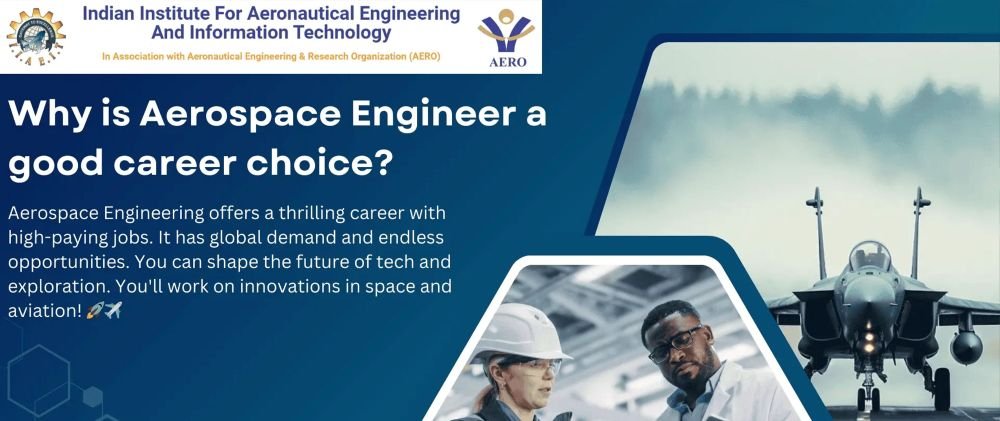
Is Aerospace Engineering a Good Career?
Yes, aerospace engineering is an excellent career choice for students who are passionate about aviation, space technology, and cutting-edge innovation. It offers competitive salaries, strong long-term job security, and the rare opportunity to work on projects that genuinely push the limits of human capability.
But passion alone is not enough to make an informed decision. This guide answers every major question students ask, from salary expectations and future scope to whether a B.Tech in aerospace engineering is actually worth it.
What Is Aerospace Engineering?
Aerospace engineering is the branch of engineering focused on designing, developing, testing, and maintaining aircraft, spacecraft, satellites, missiles, and related systems. It is broadly divided into two streams:
- Aeronautical Engineering covers vehicles that operate within Earth’s atmosphere, commercial aircraft, fighter jets, helicopters, and drones.
- Astronautical Engineering deals with vehicles designed for space, rockets, satellites, space stations, and interplanetary probes.
The discipline draws from fluid dynamics, thermodynamics, structural engineering, materials science, propulsion, avionics, and control systems. It is one of the most multidisciplinary fields in all of engineering.
Aerospace Engineering Scope in India and Globally
Scope in India
India’s aerospace sector is expanding faster than at any point in its history. Several factors are driving this:
- ISRO’s growing ambitions, from Chandrayaan and Gaganyaan to the Bharatiya Antariksha Station planned for 2035, ISRO is hiring and investing at scale.
- Private space companies, Skyroot Aerospace, Agnikul Cosmos, Pixxel, and dozens of startups are building India’s commercial space economy.
- Defence modernisation, India’s defence budget crossed ₹6.2 lakh crore in 2024-25, with a major push toward indigenous manufacturing under Make in India.
- Aviation growth, India is on track to become the world’s third-largest aviation market. Airlines, MRO (Maintenance, Repair & Overhaul) companies, and airport infrastructure all need aerospace engineers.
Major hiring hubs in India include Bengaluru, Hyderabad, Pune, Chennai, and Delhi NCR.
Global Scope
Internationally, aerospace engineering scope remains strong. The commercial aviation sector is recovering and expanding post-pandemic, while the global space economy, valued at over $630 billion, is projected to reach $1 trillion by 2040. Companies like Boeing, Airbus, SpaceX, NASA, ESA, Lockheed Martin, and Raytheon continue to be significant employers.
Is Aerospace Engineering a Good Career for the Future?
Absolutely. Here is why aerospace engineering career holds strong long-term prospects:
- Space exploration is entering a new era. Government and private investment in space is at an all-time high globally. Engineers with expertise in propulsion, orbital mechanics, and spacecraft systems are in strong demand.
- Sustainable aviation is a growing priority. The push for electric aircraft, hydrogen-powered planes, and reduced-emission engines is creating entirely new engineering challenges, and opportunities.
- Defence technology is expanding. Unmanned aerial vehicles (UAVs), hypersonic missiles, and advanced radar systems require aerospace engineers at every stage of development.
- AI and data are transforming the industry. Aerospace engineers who combine domain expertise with knowledge of simulation software, machine learning, and digital twin technology will be especially valuable.
The future of aerospace engineering is not just bright, it is one of the few fields where the scope is actively expanding, not contracting.
Benefits of Aerospace Engineering as a Career
- Competitive and Growing Salary
Aerospace engineers in India start at ₹6–8 lakhs per annum and can reach ₹15–25 lakhs or more with experience and specialisation. Senior roles in defence PSUs or space agencies can exceed this significantly.
- Intellectually Stimulating Work
No two projects are the same. Whether you are designing a satellite, optimising a jet engine, or stress-testing a fuselage, the work is complex, varied, and deeply satisfying for problem-solvers.
- Strong Job Stability
Unlike many sectors vulnerable to automation or outsourcing, aerospace engineering requires highly specialised, security-cleared professionals. This creates natural job protection.
- Prestige and National Importance
Working on India’s space programme or defence systems is work that carries genuine national significance. Aerospace engineers contribute to projects that make headlines and shape history.
- Clear Career Progression
From junior design engineer to systems lead, project manager, or chief engineer, the career ladder in aerospace is well-defined. Specialisation in avionics, propulsion, or structures accelerates growth.
- Global Mobility
An aerospace engineering degree is highly transferable. Engineers trained in India regularly find opportunities in Europe, the US, the Middle East, and Southeast Asia.
- Continuous Learning
The field never stands still. Employers routinely sponsor certifications, advanced training, and conference participation, keeping engineers at the frontier of knowledge.
- Cross-Disciplinary Exposure
Aerospace engineers work alongside material scientists, software developers, physicists, and systems analysts. This breadth of exposure makes you a more versatile and valuable professional over time.
Advantages of Aerospace Engineering Over Other Fields
Compared to general mechanical or civil engineering, aerospace engineering offers:
- Higher entry-level salaries due to the specialised skill set required
- Access to cutting-edge technology not found in most other industries
- Exposure to both public sector (ISRO, HAL, DRDO, NAL) and private sector opportunities
- A global job market rather than a primarily domestic one
- Work on products, aircraft, rockets, satellites, with a long operational life and visible impact
The main trade-off is that the field is more specialised, meaning your career is more concentrated in specific industries. For students who are genuinely interested in aviation and space, this is a feature, not a limitation.
Is B.Tech in Aerospace Engineering Good?
Yes, a B.Tech in Aerospace Engineering is a strong and credible foundation for a career in the field, provided you choose a well-structured programme with proper lab infrastructure and industry exposure.
Here is what a good B.Tech programme covers:
- Core Engineering: Mathematics, physics, engineering mechanics, thermodynamics
- Aerospace-Specific Subjects: Fluid dynamics, aerodynamics, propulsion systems, flight mechanics, structural analysis
- Design and Software: CAD tools (CATIA, SolidWorks), simulation software (ANSYS, MATLAB), and avionics systems
- Practical Training: Wind tunnel testing, material testing, prototype development, and industry internships
At IIAEIT Pune, the B.Tech Aerospace Engineering programme is designed around both theoretical rigour and hands-on application, preparing students for roles in aviation, defence, and the emerging space sector right from day one.
A B.Tech is sufficient for most entry-level and mid-level roles. An M.Tech or a specialised Master’s becomes valuable if you want to work in research, academia, or highly technical roles in propulsion or systems engineering.
Is Doing Aerospace Engineering Worth It?
The honest answer: it depends on what you want from your career.
Aerospace engineering is worth it if:
- You have genuine interest in aircraft, spacecraft, or defence systems
- You are comfortable with a career path that requires continuous learning
- You are willing to be geographically flexible, at least in early years
- You want a career with national and global significance
It may not be the right fit if:
- You are primarily motivated by the highest possible starting salary (some IT and finance roles pay more at entry level)
- You want a field with opportunities in every city and town
- You are not interested in the technical depth the field demands
For the right student, aerospace engineering is absolutely worth it. The combination of intellectual challenge, career growth, salary potential, and the sheer scale of what you get to work on is difficult to match in other fields.
Is Aerospace Engineering a Good Degree?
As a degree, aerospace engineering is well-regarded by employers across aviation, defence, manufacturing, R&D, and even management consulting. The analytical and problem-solving skills developed during the programme are highly transferable.
Aerospace engineers also frequently move into adjacent roles in:
- Project management and systems integration
- Technical sales and business development for aerospace companies
- Quality assurance and regulatory compliance
- Data engineering and simulation for aerospace applications
- Entrepreneurship in the growing space-tech startup ecosystem
So even if your career takes a different direction over time, the degree gives you a solid and versatile foundation.
Salary Expectations for Aerospace Engineers in India
Experience Level | Approximate Annual Salary (India) |
Fresher / Entry Level | ₹6 – 8 LPA |
3–5 Years Experience | ₹10 – 15 LPA |
Senior / Specialised Roles | ₹15 – 25 LPA |
Defence PSU / Space Agency | ₹8 – 20 LPA (+ benefits) |
Private Sector (MNCs) | ₹12 – 30+ LPA |
Salaries vary based on employer (government vs. private), specialisation (propulsion engineers typically earn more than general design engineers), and location. Engineers working with global firms or in international roles can earn significantly higher.
Challenges to Be Aware Of
Being honest about the challenges is as important as highlighting the benefits:
- Competitive entry: Admission to good aerospace programmes and recruitment at top firms is competitive. Academic performance, internship experience, and skills in design software matter.
- Location dependency: Jobs are concentrated in specific cities and industrial clusters. Early-career professionals may need to relocate.
- Industry cycles: The aviation sector in particular is sensitive to economic downturns, pandemics, and fuel prices, which can temporarily affect hiring.
- Continuous skill upgradation: The technology evolves fast. Engineers who stop learning quickly become less relevant. This is a challenge, but also what makes the career engaging.
Career Paths After Aerospace Engineering
Graduates from IIAEIT’s aerospace engineering programme go on to roles including:
- Aircraft Design Engineer
- Propulsion Systems Engineer
- Avionics and Navigation Systems Engineer
- Structural Analysis Engineer
- Flight Test Engineer
- UAV / Drone Systems Engineer
- Spacecraft Systems Analyst
- Defence Research Scientist (DRDO)
- Aerospace Project Manager
- MRO (Maintenance, Repair & Overhaul) Specialist
Major employers include HAL, ISRO, DRDO, NAL, Air India, IndiGo (engineering divisions), Airbus India, Boeing India, Safran, Honeywell Aerospace, and a rapidly growing number of space-tech startups.
Frequently Asked Questions
Q 1. Is aerospace engineering a good career in India?
Yes. With India’s expanding space programme, defence modernisation, and aviation growth, aerospace engineering offers strong and improving career prospects in India.
Q 2. What is the scope of aerospace engineering in the future?
The scope is very strong. Growth in commercial aviation, private space exploration, UAV technology, sustainable aviation, and hypersonic systems will all drive demand for aerospace engineers through 2030 and beyond.
Q 3. Is B.Tech in aerospace engineering good for getting a job?
Yes, provided you study at an institution with proper industry exposure, lab facilities, and internship opportunities. A B.Tech is the standard entry qualification for most aerospace roles.
Q 4. What are the main benefits of aerospace engineering?
Competitive salaries, intellectually stimulating work, job stability, prestige, global mobility, and the opportunity to contribute to nationally significant projects.
Q 5. Is doing aerospace engineering worth it compared to other streams?.
For students genuinely interested in aviation, space, or defence, yes, the combination of career satisfaction, growth potential, and compensation is difficult to match. For students purely chasing the highest starting salary, other fields like software engineering may offer more at entry level.
Q 6. What is the starting salary for aerospace engineers in India?
Typically ₹6–8 LPA at entry level, rising to ₹15–25 LPA with experience and specialisation.
Q 7. Is aerospace engineering a good degree in terms of transferable skills?
Yes. The analytical rigour, software proficiency, systems thinking, and problem-solving skills developed in aerospace engineering are valued across multiple industries.
Conclusion: Is Aerospace Engineering the Right Career for You?
Aerospace engineering is one of the most rewarding careers available to engineering students today. It combines technical depth with real-world impact, offers strong salary growth, and sits at the intersection of some of the most exciting developments of our time, from reusable rockets to electric aircraft to hypersonic defence systems.
Is it for everyone? No. It demands commitment, continuous learning, and a genuine passion for the field. But for students who have that passion, it is one of the best career decisions they can make.
If you are considering aerospace engineering, IIAEIT’s B.Tech and M.Tech programmes in Pune are designed to give you both the theoretical foundation and the practical skills that employers in aviation, defence, and space technology actually look for. [Explore the programme here] or [book a campus tour] to see the facilities for yourself.