Tejas Aircraft Crash: Lessons for India’s Aerospace Future & the Growing Need for Skilled Aeronautical Engineers
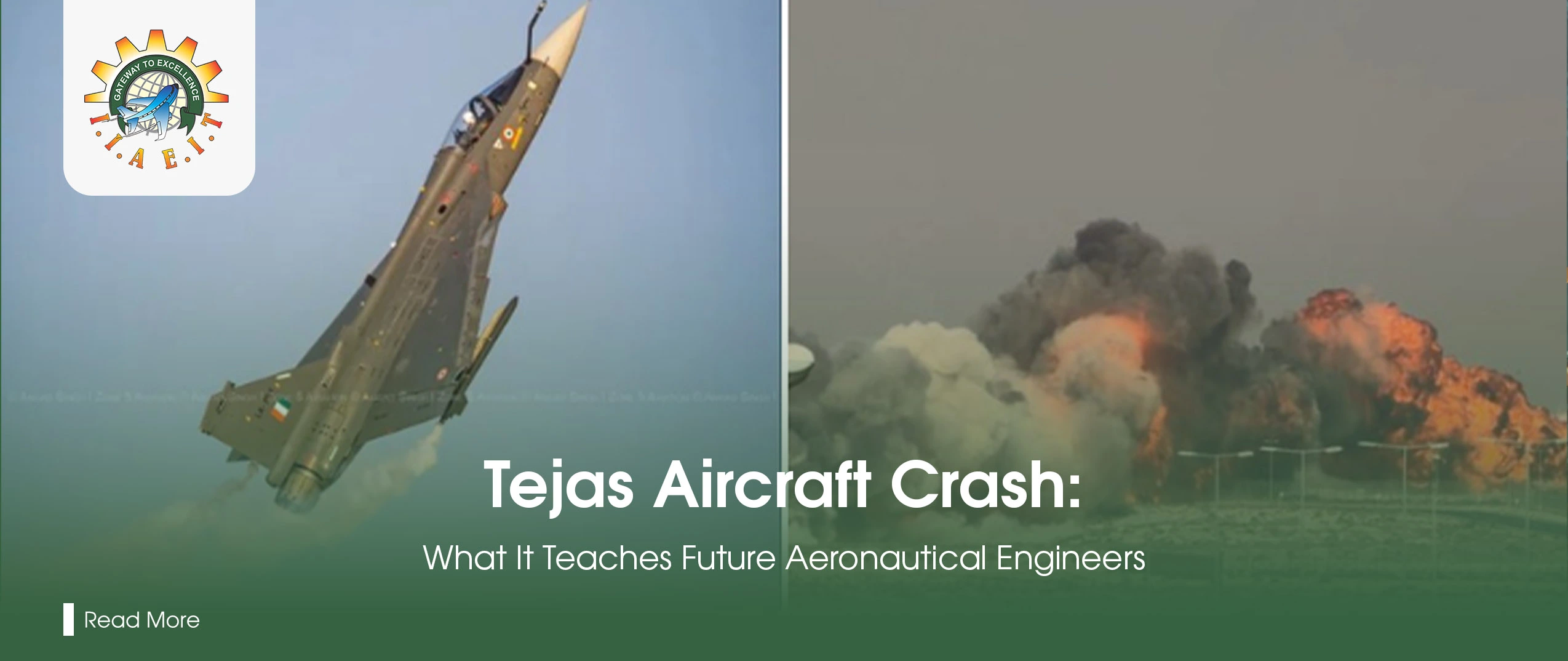
The recent discussions surrounding a Tejas aircraft crash have once again raised questions on aviation safety, aircraft design standards, and pilot training into national focus. While investigations determine the technical causes behind such incidents, one thing becomes clear: the importance of highly trained aeronautical engineers, advanced research capabilities, and continuous innovation & making them the need of the hour.
India’s indigenous fighter jet, the HAL Tejas, represents the country’s growing strength in defense aviation. However, like every complex aircraft system worldwide, occasional incidents highlight the importance of engineering precision, system testing, and expert maintenance. This is where institutions like IIAEIT (Indian Institute for Aeronautical Engineering & Information Technology) play a crucial role in shaping the next generation of aerospace professionals in a way that would instill in them the expertise to ensure such unfortunate events don’t occur.
Understanding the Tejas Aircraft
The HAL Tejas is a lightweight, multirole supersonic fighter aircraft developed in India. It was designed to replace aging aircraft in the Indian Air Force fleet and represents a major milestone and a feather in the hat for India’s aerospace self-reliance mission.
Key features include:
- Advanced composite airframe
- Digital fly-by-wire control system
- Modern avionics suite
- Supersonic capability
- Multi-role combat performance
Despite its technological advancements, modern fighter jets operate under extreme aerodynamic, mechanical, and electronic stress. Even minor technical irregularities can lead to emergencies, making engineering accuracy and rigorous testing absolutely critical.
What a Tejas Aircraft Crash Teaches Us
When any fighter aircraft experiences a crash, investigations typically analyze:
- Flight control systems
- Engine performance
- Avionics functionality
- Structural integrity
- Human factors and pilot inputs
- Maintenance records
- Environmental conditions
Every one of these factors directly connects to aeronautical engineering disciplines.
Such incidents are not just about aviation risk; they are powerful learning opportunities for the aerospace community. They reinforce the importance of:
- Robust aircraft design
- Quality testing procedures
- Simulation-based training
- Predictive maintenance systems
- Skilled technical manpower
The Role of Aeronautical Engineers in Preventing Aircraft Crashes
Behind every successful aircraft mission stands a team of engineers responsible for:
- Aerodynamics & Structural Analysis – Ensuring the aircraft can withstand extreme speeds, pressure, and maneuvering loads.
- Propulsion System Engineering – Monitoring engine reliability and fuel efficiency.
- Avionics & Flight Control Systems – Maintaining digital fly-by-wire systems and onboard electronics.
- Maintenance & Quality Assurance – Routine inspections and advanced diagnostics to prevent system failures.
- Simulation & Testing – Running virtual stress tests before real-world deployment.
The complexity of modern aircraft like Tejas highlights why specialized aeronautical education is no longer optional; it is essential.
Why India Needs More Skilled Aeronautical Engineers
India is rapidly expanding in:
- Defense aviation
- Drone technology
- Space exploration
- Commercial aircraft maintenance
- Indigenous aircraft manufacturing
The “Make in India” initiative and increasing defense budgets have strengthened the domestic aerospace ecosystem. However, infrastructure alone is not enough. The country requires technically sound, research-oriented, and industry-ready engineers.
This is where structured, practical, and industry-integrated programs become critical.
Relevance of IIAEIT’s Aeronautical Engineering Program
IIAEIT offers specialized programs in Aeronautical, Aerospace, and Avionics Engineering designed to meet modern industry demands.
Here’s how its curriculum directly aligns with lessons from incidents like the Tejas aircraft crash:
Strong Foundation in Aerodynamics
Understanding airflow behavior, drag, lift, and structural stress is fundamental. At IIAEIT, students study:
- Fluid Mechanics
- Aerodynamics
- Aircraft Structures
- Flight Mechanics
These subjects help engineers identify potential weaknesses in aircraft performance under extreme conditions.
Advanced Propulsion & Engine Studies
Jet engines operate at extremely high temperatures and pressures. IIAEIT’s propulsion modules prepare students to:
- Analyze turbine systems
- Study combustion processes
- Evaluate engine performance
- Diagnose technical faults
Such expertise is vital for preventing engine-related failures.
Avionics & Fly-By-Wire Systems
Modern fighter aircraft like Tejas rely heavily on digital flight control systems. IIAEIT’s avionics training covers:
- Control systems engineering
- Embedded electronics
- Aircraft instrumentation
- Digital communication systems
This prepares graduates to work on high-tech aviation platforms.
Emphasis on Simulation & Testing
One of the biggest preventive measures against aircraft accidents is simulation-based testing. IIAEIT integrates:
- CAD & aircraft design software
- Simulation tools
- Wind tunnel experimentation
- Project-based learning
Students gain practical exposure that mirrors real aerospace industry challenges.
Focus on Research & Innovation
Aerospace is a constantly evolving domain. IIAEIT encourages:
- Research projects
- Industry collaboration
- Aerospace innovation
- Defense technology exploration
This ensures graduates are not just job-ready but future-ready.
What is the impact of education on aviation safety?
Aviation safety is built on three pillars:
- Engineering precision
- Continuous maintenance
- Skilled manpower
Institutes that combine theoretical depth with practical training significantly reduce the skill gap in the aerospace sector.
Well-trained engineers contribute to:
- Safer aircraft systems
- Improved diagnostic techniques
- Better material engineering
- Enhanced flight testing procedures
Events like a Tejas aircraft crash remind us that aerospace engineering is not merely about building aircraft; it is about ensuring safety, reliability, and national security.
Building a Safer Aerospace Future
The aerospace industry thrives on learning from every incident. Each technical investigation strengthens design improvements, engineering standards, and safety protocols.
For aspiring students inspired by aviation and defense, this is the right time to pursue a structured and specialized aeronautical engineering program.
Choosing a focused institute like IIAEIT means gaining:
- Industry-relevant curriculum
- Practical lab exposure
- Aerospace specialization
- Defense technology orientation
- Career-ready skill development
Conclusion
The Tejas aircraft represents India’s pride in indigenous fighter technology. While any aircraft incident is unfortunate, it also reinforces the need for deeper research, stronger engineering expertise, and highly skilled professionals.
Aeronautical engineering is not just a career; it is a responsibility toward aviation safety and national advancement.
With its specialized programs in aerospace and defense technology, IIAEIT is contributing to the development of future-ready engineers who can strengthen India’s aviation ecosystem and help build a safer, more advanced aerospace future, making the country proud.
If you aspire to design, test, and safeguard the aircraft of tomorrow, the journey begins with the right education, and that education starts at IIAEIT.