
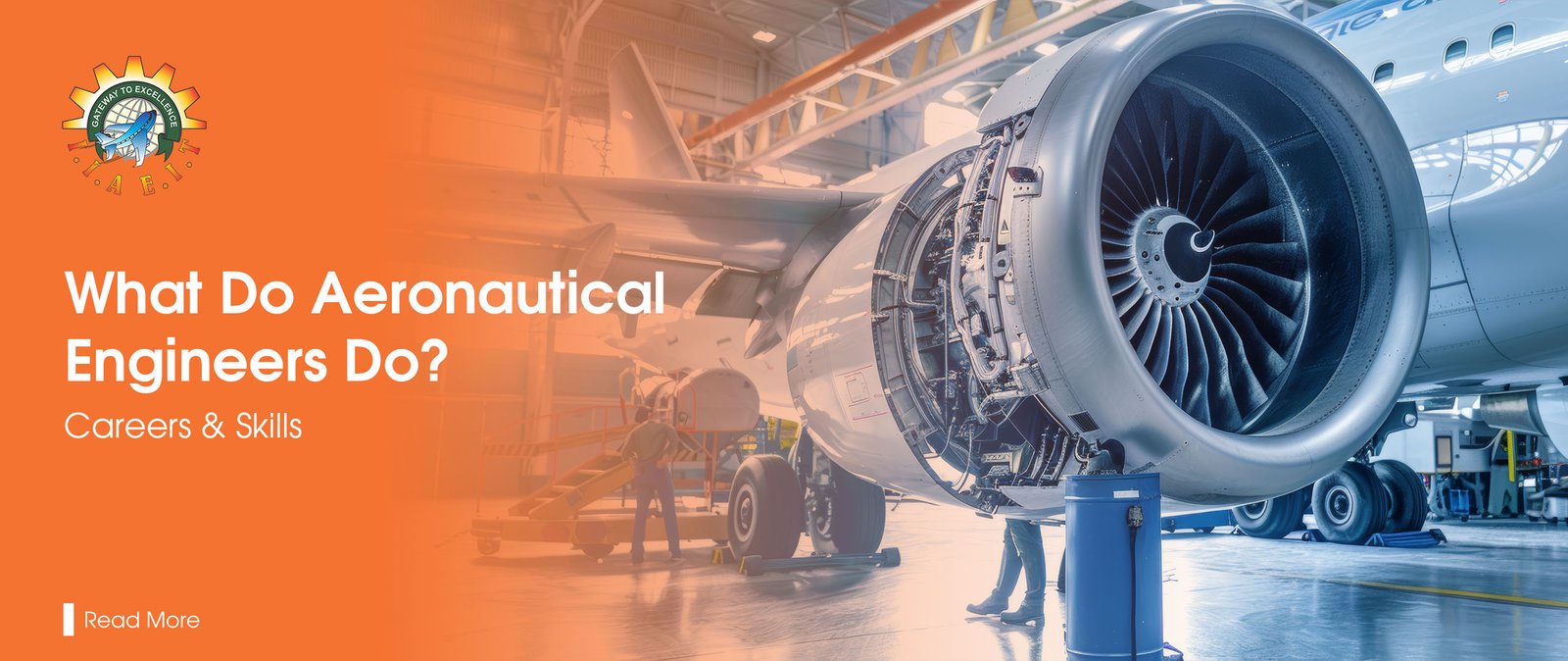
Have you ever wondered who designs the wings of an aircraft, develops its engines, analyses its flight performance or ensures that its structure can withstand extreme operating conditions? These responsibilities form an important part of the work performed by aeronautical engineers.
Aeronautical engineering is a specialised branch of engineering that combines physics, mathematics, aerodynamics, propulsion, structural mechanics and advanced computational technologies to develop aircraft and aviation systems.
From commercial aeroplanes and fighter jets to helicopters, drones and guided missile systems, aeronautical engineers contribute to designing, developing, testing and improving different types of flying platforms.
As aviation technology continues to advance, the field offers opportunities across aircraft manufacturing, defence, unmanned aerial vehicles (UAVs), aerospace research and engineering development.
For students considering this career, understanding what aeronautical engineers do, what they learn during their degree and what career options are available after graduation can help them make an informed academic decision.
At the Indian Institute for Aeronautical Engineering and Information Technology (IIAEIT), Pune, students can explore a specialised four-year B.Tech in Aeronautical Engineering that covers aircraft design, aerodynamics, structural analysis, propulsion systems, flight mechanics and control technologies.
What Do Aeronautical Engineers Do?
Aeronautical engineers design, develop, analyse, test and improve aircraft and their associated systems. Their work involves applying engineering principles to make aircraft structurally sound, aerodynamically efficient, reliable and capable of performing their intended functions.
Their responsibilities extend across different stages of an aircraft’s lifecycle, from initial design and simulation to manufacturing, testing and performance improvement.
Depending on their technical specialisation, aeronautical engineers may work on aircraft structures, engines, aerodynamic systems, flight controls or unmanned aerial vehicles.
Here are the major responsibilities of an aeronautical engineer:
1. Design and Develop Aircraft
Aircraft design is one of the primary areas of aeronautical engineering.
Engineers develop aircraft configurations and components such as wings, fuselages, landing gear, control surfaces and other structural elements.
They consider factors such as aerodynamic efficiency, weight, stability, strength and operating requirements while developing aircraft designs.
Modern engineering software allows designers to create three-dimensional models, evaluate configurations and identify potential design limitations before manufacturing begins.
2. Analyse Aerodynamic Performance
Aerodynamics studies how air interacts with moving objects, particularly aircraft.
Aeronautical engineers analyse the forces acting on aircraft during flight, including:
- Lift: The aerodynamic force that helps an aircraft remain airborne.
- Drag: The resistance experienced by an aircraft as it moves through air.
- Thrust: The forward force generated by the propulsion system.
- Weight: The gravitational force acting on the aircraft.
Engineers study airflow around wings, fuselages and other surfaces to understand aircraft performance.
They also use Computational Fluid Dynamics (CFD) to simulate airflow, evaluate aerodynamic behaviour and improve aircraft configurations.
3. Develop and Evaluate Aircraft Propulsion Systems
Aircraft engines generate the thrust required for flight. Aeronautical engineers involved in propulsion work on understanding, analysing and improving these systems.
Their responsibilities may include:
- Studying gas-turbine engine performance.
- Analysing compressors and turbines.
- Evaluating combustion processes.
- Studying nozzle flow and thrust generation.
- Assessing propulsion efficiency.
- Analysing engine performance under different operating conditions.
This specialisation plays an important role in developing efficient aircraft propulsion technologies.
4. Perform Aircraft Structural Analysis
Aircraft structures must withstand aerodynamic forces, vibrations, pressure variations and different operating conditions.
Aeronautical engineers analyse the structural strength and durability of components such as wings, fuselages and supporting structures.
Their work involves:
- Stress and strain analysis.
- Fatigue and fracture mechanics.
- Structural modelling.
- Composite material evaluation.
- Buckling analysis.
- Finite Element Analysis (FEA).
These processes help engineers assess structural performance and identify potential weaknesses in aircraft components.
5. Work on Flight Mechanics and Stability
Flight mechanics deals with aircraft movement, performance, stability and control.
Aeronautical engineers study how aircraft respond to pilot inputs, aerodynamic forces and changing flight conditions.
Their work includes analysing:
- Aircraft equations of motion.
- Longitudinal and lateral stability.
- Flight performance.
- Manoeuvring characteristics.
- Flight envelopes.
- Stability and control systems.
This knowledge helps engineers understand aircraft behaviour and contribute to the development of reliable flight-control technologies.
6. Develop Aircraft Control and Guidance Systems
Modern aircraft rely on sophisticated control and guidance systems to maintain stability, navigate and perform different flight operations.
Aeronautical engineers working in this area study aircraft dynamics, control algorithms, autopilot systems, navigation and guidance technologies.
These applications are also important in unmanned aerial vehicles and defence platforms.
7. Conduct Testing and Performance Evaluation
Aircraft components and systems undergo extensive testing before they are approved for operational use.
Aeronautical engineers contribute to testing and evaluation by analysing engineering data, studying system behaviour and identifying areas for improvement.
Depending on their role, they may participate in structural testing, aerodynamic simulations, propulsion performance studies and flight-dynamics evaluations.
8. Participate in Research and Development
Aeronautical engineers also contribute to developing emerging aviation technologies.
Their research may involve:
- Advanced aircraft configurations.
- Lightweight composite materials.
- Hypersonic aerodynamics.
- Unmanned aerial vehicles.
- Advanced propulsion systems.
- Aircraft automation and control.
- Improved aerodynamic efficiency.
These areas support innovation across civil aviation, defence and aerospace research.
What Does an Aeronautical Engineer Do in Different Industries?
The responsibilities of an aeronautical engineer can vary significantly depending on the industry and organisation.
A professional working in aircraft manufacturing may focus on structural design, while someone working in defence research may contribute to advanced flight systems or UAV technologies.
The following table explains how aeronautical engineering knowledge is applied across different industries.
| Industry | What Aeronautical Engineers Do |
| Aircraft Manufacturing | Design and analyse aircraft structures, components and systems |
| Civil Aviation | Support aircraft engineering, performance evaluation and technical operations |
| Defence and Military Aviation | Contribute to military aircraft, UAVs and defence aviation technologies |
| UAV and Drone Technology | Develop aircraft configurations, flight-control systems and performance models |
| Aerospace Research | Conduct research involving aerodynamics, propulsion and advanced materials |
| Aircraft MRO | Contribute to engineering analysis, inspection support and maintenance-related technical processes |
| Engineering and Simulation | Develop computational models and perform structural, aerodynamic and flight simulations |
Organisations such as Hindustan Aeronautics Limited (HAL), Defence Research and Development Organisation (DRDO), National Aerospace Laboratories (NAL), Boeing and Airbus operate across different areas of aviation and aerospace engineering.
Recruitment requirements and available engineering roles vary across these organisations.
What Do We Learn in Aeronautical Engineering?
A B.Tech in Aeronautical Engineering introduces students to the scientific principles and technical applications involved in aircraft design and development.
The programme generally begins with foundational subjects such as engineering mathematics, physics and mechanics before progressing towards specialised subjects involving aircraft systems.
At IIAEIT Pune, the B.Tech Aeronautical Engineering programme covers several important technical domains.
1. Aerodynamics
Aerodynamics is one of the fundamental subjects of aeronautical engineering.
Students learn how air flows around aircraft surfaces and how aerodynamic forces influence aircraft performance.
Topics include:
- Lift and drag.
- Airfoil and wing characteristics.
- Boundary-layer behaviour.
- Subsonic and supersonic airflow.
- Shock wave formation.
- Aerodynamic optimisation.
- Computational Fluid Dynamics.
Students develop an understanding of how aerodynamic principles influence aircraft design and flight performance.
2. Aircraft Propulsion Systems
Aircraft propulsion focuses on the systems responsible for generating thrust.
Students learn the working principles of gas-turbine engines and other propulsion technologies.
Topics include:
- Thermodynamic cycle analysis.
- Compressor and turbine operation.
- Combustion processes.
- Nozzle flow.
- Gas-turbine performance.
- Rocket propulsion principles.
- Thrust optimisation.
These concepts help students understand how propulsion systems contribute to aircraft performance.
3. Structural and Stress Analysis
Aircraft structures must remain strong, lightweight and durable.
Students learn how different forces affect aircraft components and how engineers evaluate their structural behaviour.
Important topics include:
- Stress and strain.
- Structural mechanics.
- Fatigue and fracture mechanics.
- Composite materials.
- Finite Element Modelling (FEM).
- Buckling analysis.
- Structural optimisation.
This subject develops the analytical skills required to evaluate aircraft structures.
4. Flight Mechanics
Flight mechanics examines the movement and performance of aircraft.
Students learn how aircraft respond to different forces and operating conditions.
Topics include:
- Equations of motion.
- Longitudinal stability.
- Lateral and directional stability.
- Aircraft performance calculations.
- Range and endurance.
- Climb and turn performance.
- Flight-envelope analysis.
These concepts are important for understanding aircraft behaviour and performance.
5. Aircraft Control and Guidance
This subject focuses on the systems that regulate aircraft movement and support navigation.
Students explore:
- Aircraft dynamics.
- Stability derivatives.
- State-space control.
- Autopilot design.
- Navigation systems.
- Guidance algorithms.
- Flight-control technologies.
These concepts are relevant to both manned and unmanned aircraft.
6. Computational Fluid Dynamics (CFD)
CFD uses numerical methods and computational tools to simulate fluid behaviour.
In aeronautical engineering, it helps engineers analyse airflow around aircraft components and evaluate aerodynamic performance.
Students develop an understanding of simulation methods, flow analysis and aerodynamic optimisation.
7. CAD, CAE and Engineering Simulation
Computer-Aided Design (CAD) and Computer-Aided Engineering (CAE) tools are widely used in modern aircraft development.
Students learn how engineering software supports three-dimensional modelling, structural evaluation and simulation-based design.
At IIAEIT, the Aeronautical Engineering programme provides exposure to CAD/CAE tools, finite-element structural modelling, CFD flow simulations and virtual flight-dynamics simulation environments.
8. Aircraft Systems and Emerging Technologies
Students also explore the engineering systems used across modern aviation platforms.
These include aircraft control systems, navigation technologies, unmanned aerial vehicles and other advanced aviation applications.
Understanding these systems helps students develop a broader perspective on how different aircraft technologies work together.
What Practical Skills Do You Develop During Aeronautical Engineering?
Aeronautical engineering is an application-oriented discipline. Students need to understand not only the scientific principles behind aircraft but also how to apply them to engineering problems.
During their undergraduate education, students can develop the following skills:
| Skill | Application in Aeronautical Engineering |
| CAD Modelling | Creating aircraft components and engineering designs |
| CFD Simulation | Analysing airflow and aerodynamic performance |
| Finite Element Analysis | Evaluating structural strength and behaviour |
| Mathematical Modelling | Analysing aircraft dynamics and engineering systems |
| Technical Analysis | Interpreting engineering data and simulation results |
| Problem-Solving | Identifying and addressing engineering challenges |
| Research Skills | Investigating new technologies and technical concepts |
| Team Collaboration | Working on multidisciplinary engineering projects |
At IIAEIT Pune, the programme focuses on theoretical and practical sessions, design and investigatory projects, field and analytical projects, industrial training and research publication guidance.
Students also have access to MOOCs and industrial certification opportunities.
What Should I Study to Become an Aeronautical Engineer?
If you are planning to become an aeronautical engineer, your academic preparation should begin with a strong foundation in science and mathematics.
These subjects are important because aeronautical engineering involves understanding physical forces, mathematical relationships, fluid behaviour and mechanical systems.
1. Study Physics in Class 11 and 12
Physics is one of the most important subjects for aspiring aeronautical engineers.
Focus on understanding:
- Laws of motion.
- Work, energy and power.
- Rotational mechanics.
- Gravitation.
- Thermodynamics.
- Oscillations and waves.
- Properties of matter.
These concepts provide the foundation for understanding aircraft movement, forces and propulsion.
2. Develop Strong Mathematical Skills
Mathematics plays a central role in aircraft design, structural analysis, aerodynamics and flight mechanics.
Important mathematical concepts include:
- Algebra.
- Trigonometry.
- Calculus.
- Vectors.
- Differential equations.
- Coordinate geometry.
- Probability and statistics.
Developing mathematical problem-solving skills will help you understand advanced engineering subjects.
3. Study Chemistry and Engineering Fundamentals
Chemistry is relevant to understanding materials, combustion processes and the properties of substances used in aircraft engineering.
Students should also develop an understanding of basic engineering principles, mechanics and materials science during their undergraduate studies.
4. Pursue B.Tech in Aeronautical Engineering
After completing Class 12, the next step is to meet the eligibility requirements and secure admission to an undergraduate engineering programme.
A four-year B.Tech in Aeronautical Engineering provides specialised education in aircraft design, propulsion, aerodynamics, structures and flight mechanics.
Students who have completed an eligible three-year Engineering Diploma may also explore applicable admission pathways.
5. Develop Technical and Software Skills
Alongside academic subjects, aspiring aeronautical engineers should develop familiarity with engineering applications and computational tools.
Some useful areas to explore include:
- Computer-Aided Design (CAD).
- Computer-Aided Engineering (CAE).
- Computational Fluid Dynamics (CFD).
- Finite Element Analysis (FEA).
- Programming and mathematical modelling.
- Engineering simulation.
These skills can help students apply theoretical concepts to practical engineering challenges.
What to Do After an Aeronautical Engineering Bachelor’s Degree?
Completing a B.Tech in Aeronautical Engineering opens different academic and professional pathways.
Students can enter the workforce, pursue postgraduate education, specialise in emerging technologies or explore research opportunities.
The right pathway depends on their interests, technical strengths and long-term career objectives.
1. Start a Career in the Aviation and Aerospace Industry
Graduates can explore entry-level engineering opportunities across aircraft manufacturing, aviation, defence, UAV development and engineering services.
Some relevant job profiles include:
Aerodynamics Engineer: Analyses airflow, lift, drag and aircraft aerodynamic performance.
Aircraft Design Engineer: Works on aircraft configurations, components and engineering designs.
Structural Analysis Engineer: Evaluates aircraft structural strength, stress distribution and material behaviour.
Propulsion Engineer: Studies aircraft engines, gas turbines and propulsion performance.
Flight Dynamics Engineer: Analyses aircraft stability, movement, performance and control systems.
UAV Development Engineer: Works on drone design, flight control and unmanned aircraft systems.
Engineering Simulation Engineer: Uses computational tools to analyse aircraft structures, airflow and engineering performance.
Entry requirements vary by employer. Some positions may require additional training, relevant software skills or specialised qualifications.
2. Pursue an M.Tech in Aerospace or Aeronautical Engineering
Students interested in advanced technical knowledge can pursue postgraduate education.
An M.Tech in Aerospace Engineering or a related specialisation allows graduates to explore specific engineering domains in greater depth.
Possible areas of specialisation include:
- Aerodynamics and Fluid Mechanics.
- Aerospace Structures.
- Aircraft Propulsion.
- Flight Mechanics and Control.
- Avionics.
- Space Technology.
- Computational Engineering.
Postgraduate qualifications can support progression into specialised engineering, research and academic roles.
3. Explore Defence and Government Research Opportunities
Aeronautical engineering graduates can explore recruitment opportunities in defence and government-related engineering organisations.
Relevant organisations include:
- Hindustan Aeronautics Limited (HAL).
- Defence Research and Development Organisation (DRDO).
- National Aerospace Laboratories (NAL).
- Indian Space Research Organisation (ISRO).
Depending on the recruitment notification, graduates may apply for engineering, technical, research or other relevant positions.
Eligibility, examinations, academic requirements and selection procedures differ across organisations and posts.
4. Specialise in UAV and Drone Technology
Unmanned aerial vehicles have applications across defence, surveillance, agriculture, infrastructure inspection, mapping and other industries.
Aeronautical engineering graduates can explore specialised learning in:
- UAV configuration and design.
- Flight dynamics.
- Drone aerodynamics.
- Flight-control systems.
- Navigation and guidance.
- Autonomous flight technologies.
- UAV performance analysis.
This is an emerging technical area that combines aeronautical engineering with electronics, software and control systems.
5. Pursue Research and Development
Students interested in innovation and advanced engineering can explore research-oriented careers.
Research opportunities may involve aircraft configurations, propulsion systems, aerodynamic optimisation, lightweight materials, flight-control technologies and advanced simulation.
Students interested in academic or scientific research can also consider doctoral programmes after completing the required postgraduate qualifications.
6. Pursue an Integrated B.Tech + M.Tech Pathway
Students who want to plan their undergraduate and postgraduate education together can explore integrated engineering programmes.
IIAEIT offers a five-year integrated B.Tech + M.Tech in Aerospace Engineering, providing a pathway that combines undergraduate engineering education with postgraduate-level learning.
This programme is relevant to students interested in developing technical expertise across aeronautical engineering and space technology.
Career Pathways After B.Tech Aeronautical Engineering
| Career Path | Possible Direction |
| Employment | Aircraft manufacturing, aviation and engineering services |
| Higher Education | M.Tech in Aerospace or related specialisation |
| Defence | Engineering and technical recruitment opportunities |
| UAV Technology | Drone design, control and development |
| Research | Aerospace R&D and advanced engineering |
| Integrated Education | B.Tech + M.Tech in Aerospace Engineering |
| Academia | Higher studies followed by teaching and research |
How Does IIAEIT Pune Prepare Students for Aeronautical Engineering Careers?
Choosing the right engineering institute is an important part of building a career in aviation and aerospace technology.
Students should evaluate an institute based on its curriculum, practical learning opportunities, technical exposure, projects and opportunities to develop engineering skills.
The Indian Institute for Aeronautical Engineering and Information Technology (IIAEIT), Pune, offers specialised engineering education through its Aeronautical and Aerospace programmes.
Established in 2001, the institute focuses on aeronautical, aerospace and related engineering domains.
Here are some programme features that students can explore at IIAEIT.
1. Specialised B.Tech Aeronautical Engineering Programme
IIAEIT offers a four-year full-time B.Tech in Aeronautical Engineering.
The programme focuses on aircraft and aviation systems, including fixed-wing aircraft, helicopters, UAVs and civil and defence aviation platforms.
Students develop technical knowledge across aircraft configuration design, aerodynamics, propulsion, structural analysis, flight mechanics and control.
2. Practical and Simulation-Based Learning
Aeronautical engineering involves complex technical concepts that benefit from practical application.
IIAEIT provides exposure to CAD/CAE tools, finite-element structural modelling, CFD flow simulations and virtual flight-dynamics simulation environments.
This helps students understand how computational tools support aircraft design and engineering analysis.
3. Design and Investigatory Projects
Engineering projects allow students to apply classroom knowledge to technical challenges.
IIAEIT’s programme consists of design and investigatory projects, field and analytical projects, and research-oriented assignments.
Such activities can help students strengthen their analytical abilities and develop a better understanding of engineering applications.
4. Industrial Training and Additional Certifications
Professional engineering environments require knowledge of industry practices and emerging technologies.
IIAEIT focuses on industrial training opportunities, access to MOOCs and industrial certifications as part of its programme features.
These learning opportunities can complement the academic curriculum and help students explore specialised technical areas.
5. Exposure to Aircraft and Engine Models
Understanding aircraft components and systems is an important part of aeronautical education.
IIAEIT provides access to live aircraft and engine models for practical learning, providing students with opportunities to connect theoretical concepts with aviation applications.
6. Opportunities Across Aviation and Defence Technology
The programme covers technical areas relevant to aircraft manufacturing, aerospace research, defence engineering, UAV development and aviation technology.
This gives students a foundation for exploring different professional and academic pathways after graduation.
B.Tech Aeronautical Engineering at IIAEIT Pune: Course Details and Eligibility
Students interested in pursuing Aeronautical Engineering at IIAEIT can refer to the following programme information.
| Course Detail | Information |
| Institute | IIAEIT, Pune |
| Programme | B.Tech Aeronautical Engineering |
| Duration | 4 Years |
| Study Mode | Full-Time |
| Academic Focus | Aircraft Design, Aerodynamics, Propulsion, Structures and Flight Mechanics |
| Admission Route | SPACE-CET |
| Eligibility | 10+2 or 3-Year Engineering Diploma |
Eligibility Criteria
For Class 12 Students:
Candidates must have passed their 10+2 examination with Physics, Chemistry and Mathematics/Biology, securing at least:
- 45% marks in the above subjects taken together.
- 40% marks for candidates belonging to reserved categories.
For Diploma Holders:
Candidates who have completed a three-year Diploma in Engineering must secure at least:
- 45% marks for general category candidates.
- 40% marks for reserved category candidates.
An acceptable score in SPACE-CET is also required.
Students should verify the latest admission requirements and applicable eligibility conditions directly with the institute before applying.
Frequently Asked Questions About Aeronautical Engineering
Q1. What do aeronautical engineers do?
Aeronautical engineers design, develop, analyse, test and improve aircraft and aviation systems. Their work includes aircraft design, aerodynamic analysis, propulsion systems, structural evaluation, flight mechanics and aircraft performance testing.
Q2. What does an aeronautical engineer do on a daily basis?
An aeronautical engineer’s daily responsibilities depend on their specialisation. They may create aircraft designs, analyse aerodynamic simulations, evaluate structural models, study engine performance, review technical data or participate in engineering projects and testing.
Q3. What do we learn in Aeronautical Engineering?
Students learn aerodynamics, aircraft propulsion, structural analysis, flight mechanics, aircraft control and guidance, computational fluid dynamics, aircraft design and engineering simulation. They also develop mathematical, analytical and practical engineering skills.
Q4. What should I study to become an aeronautical engineer?
Students should develop a strong foundation in Physics, Mathematics and Chemistry during Class 11 and 12. They can then pursue a B.Tech in Aeronautical Engineering after meeting the applicable admission requirements.
Q5. What can I do after an Aeronautical Engineering bachelor’s degree?
After completing a B.Tech in Aeronautical Engineering, graduates can explore engineering employment, pursue an M.Tech, specialise in UAV technology, apply for eligible defence and government recruitment opportunities or enter research and development.
Q6. Is Aeronautical Engineering a good career option after 12th?
Aeronautical Engineering can be a suitable career choice for students interested in aircraft, aviation technology, defence systems, drones and engineering research. It requires strong mathematical, analytical and problem-solving abilities.
Q7. Which subjects are most important in Aeronautical Engineering?
Some of the most important subjects include aerodynamics, aircraft propulsion, flight mechanics, structural analysis, fluid mechanics, engineering mathematics, aircraft control systems and computational fluid dynamics.
Q8. Can I pursue M.Tech after B.Tech Aeronautical Engineering?
Yes. Graduates can explore postgraduate programmes such as M.Tech in Aerospace Engineering and related specialisations, subject to the admission and eligibility requirements of the respective institutions.
Q9. Can Aeronautical Engineers work in DRDO or HAL?
Aeronautical engineering graduates can explore eligible technical and engineering recruitment opportunities at organisations such as DRDO and HAL. Selection depends on the specific post, recruitment notification, academic requirements and selection process.
Q10. Is programming important in Aeronautical Engineering?
Programming and computational skills are useful in areas such as engineering simulation, flight dynamics, computational fluid dynamics, control systems and data analysis. Their importance depends on the student’s chosen specialisation.
Start Your Aeronautical Engineering Journey with IIAEIT Pune
Aeronautical engineering is a field where scientific knowledge meets real-world engineering challenges. From designing aircraft wings and analysing propulsion systems to developing UAV technologies and improving flight performance, aeronautical engineers contribute to the technologies that shape modern aviation.
For students interested in this field, the journey begins with understanding the fundamentals of science and mathematics, followed by specialised undergraduate education and practical engineering exposure.
At the Indian Institute for Aeronautical Engineering and Information Technology (IIAEIT), Pune, students can explore a dedicated B.Tech in Aeronautical Engineering that covers aircraft design, aerodynamics, propulsion, structural analysis, flight mechanics and advanced engineering simulations.