
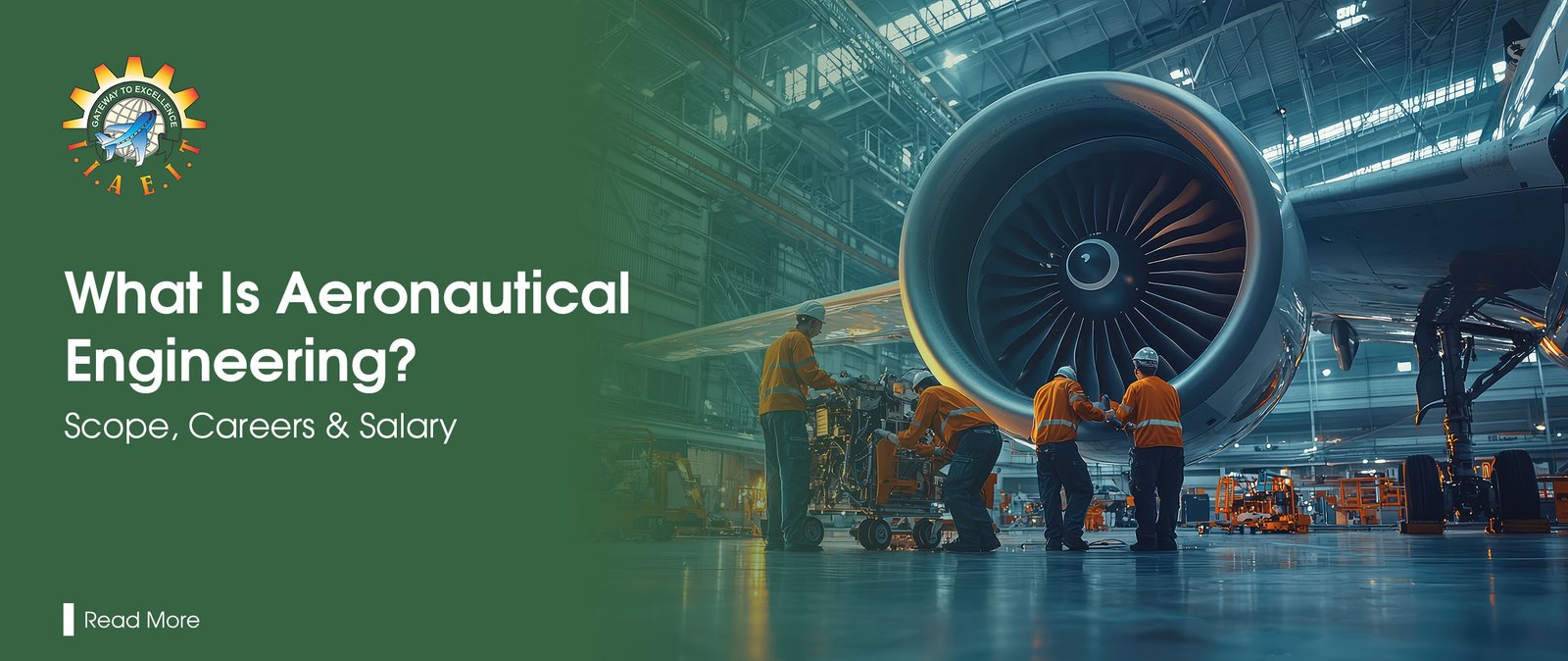
Have you ever wondered how an aircraft stays in the air, how its engines generate the thrust required for flight, or how engineers design aircraft that can travel at incredible speeds while maintaining safety and stability?
The science and engineering behind these innovations form the foundation of Aeronautical Engineering.
Aeronautical engineering is a specialised branch of engineering that focuses on the design, development, manufacturing, testing and maintenance of aircraft and other flying vehicles that operate within Earth’s atmosphere. It combines principles of physics, mathematics, aerodynamics, propulsion, structural mechanics and advanced technology to develop efficient and reliable aircraft.
From commercial passenger aircraft and fighter jets to helicopters and unmanned aerial vehicles (UAVs), aeronautical engineers contribute to the technologies that shape modern aviation.
With advancements in aviation, defence, drone technology and aerospace research, the field offers opportunities for students interested in combining engineering knowledge with practical innovation.
For students exploring this career path, understanding what aeronautical engineering involves, how it differs from aerospace engineering, its salary prospects and the qualifications required is an important first step.
At the Indian Institute for Aeronautical Engineering and Information Technology (IIAEIT), Pune, students can explore specialised undergraduate programmes in Aeronautical and Aerospace Engineering designed to develop technical knowledge and practical engineering capabilities.
What Is Aeronautical Engineering?
Aeronautical Engineering is a specialised branch of engineering concerned with the science, design, development, testing and maintenance of aircraft that operate within Earth’s atmosphere.
It involves understanding how aircraft generate lift, maintain stability, manage aerodynamic forces, produce thrust and perform under different flight conditions.
The discipline combines several engineering principles to solve complex challenges associated with aircraft performance, safety, efficiency and reliability.
Aeronautical engineers work on different components and systems of flying vehicles, including:
- Aircraft Design: Developing aircraft configurations, wings, fuselages and other structural components.
- Aerodynamics: Understanding airflow, lift, drag and the aerodynamic performance of aircraft.
- Aircraft Propulsion: Designing and analysing engines and propulsion systems that generate the thrust required for flight.
- Structural Engineering: Evaluating aircraft structures, materials, stress distribution and structural strength.
- Flight Mechanics: Studying aircraft movement, stability, control and flight performance.
- Aircraft Systems: Developing and analysing control, navigation and other essential aircraft systems.
The discipline extends beyond commercial aviation. Aeronautical engineering also contributes to military aircraft, helicopters, drones, guided missile systems and advanced aviation technologies.
At IIAEIT Pune, the B.Tech Aeronautical Engineering programme covers aircraft configuration design, structural and stress analysis, aerodynamics, computational fluid dynamics (CFD), gas-turbine propulsion, flight mechanics, stability and control, and aircraft performance optimisation.
This combination of theoretical knowledge and applied engineering helps students understand the technical principles behind modern aircraft.
What Is the Work of an Aeronautical Engineer?
An aeronautical engineer works on developing, analysing, testing and improving aircraft and their associated systems. Their responsibilities depend on their specialisation, organisation and professional experience.
Some engineers focus on aircraft design, while others work on propulsion systems, structural analysis, flight control or testing.
Here are the major responsibilities of an aeronautical engineer:
1. Aircraft Design and Development
Aeronautical engineers contribute to designing aircraft structures and configurations, including wings, fuselages, control surfaces and other components.
They evaluate design requirements, aerodynamic performance, structural strength and weight considerations to develop aircraft that meet operational requirements.
2. Aerodynamic Analysis
Aerodynamics is one of the most important areas of aeronautical engineering.
Engineers study how air flows around aircraft surfaces and analyse forces such as lift and drag. They use computational tools and simulation techniques to evaluate aircraft performance and improve aerodynamic efficiency.
Computational Fluid Dynamics (CFD) helps engineers simulate airflow and understand how different aircraft configurations behave under various conditions.
3. Aircraft Propulsion Systems
Propulsion engineers work on systems responsible for generating the thrust needed to move an aircraft.
Their work involves studying gas-turbine engines, compressors, turbines, combustion processes and nozzle performance.
They analyse engine efficiency, thrust generation and overall propulsion performance.
4. Aircraft Structural Analysis
Aircraft structures must withstand different aerodynamic forces, vibrations, pressure variations and operating conditions.
Aeronautical engineers analyse the strength, stability and durability of aircraft components.
They work with materials such as aluminium alloys and composite materials while evaluating structural performance through engineering calculations and simulation tools.
5. Flight Mechanics and Control
Flight mechanics involves understanding how aircraft move and respond to different flight conditions.
Engineers analyse aircraft stability, flight dynamics, manoeuvrability, performance and control systems.
Their work contributes to developing reliable flight-control mechanisms and improving aircraft handling characteristics.
6. Testing, Inspection and Performance Evaluation
Before aircraft systems are deployed, they undergo extensive evaluation and testing.
Aeronautical engineers contribute to analysing test results, identifying performance limitations, evaluating structural behaviour and improving aircraft systems.
They may also work with simulation environments and engineering tools to assess the performance of aircraft components.
7. Research and Technological Development
Aeronautical engineers contribute to research involving advanced aircraft configurations, unmanned aerial vehicles, propulsion technologies, lightweight materials and next-generation flight systems.
Their work supports technological advancements across commercial aviation, defence and aerospace research.
What Is the Difference Between Aerospace and Aeronautical Engineering?
One of the most common questions students ask while exploring aviation-related engineering programmes is: What is the difference between aerospace and aeronautical engineering?
Although the two disciplines share several engineering principles, they differ in their scope and applications.
Aeronautical Engineering focuses on aircraft that operate within Earth’s atmosphere, whereas Aerospace Engineering covers both atmospheric flight and space-based systems.
Aerospace engineering is the broader discipline, comprising two major branches:
- Aeronautical Engineering – Focuses on aircraft and atmospheric flight.
- Astronautical Engineering – Focuses on spacecraft, satellites, launch vehicles and systems designed for space operations.
Aerospace Engineering vs Aeronautical Engineering
| Comparison | Aeronautical Engineering | Aerospace Engineering |
| Scope | Aircraft operating within Earth’s atmosphere | Aircraft and spacecraft |
| Primary focus | Aviation and atmospheric flight | Aviation and space technology |
| Applications | Aeroplanes, helicopters and UAVs | Aircraft, satellites, spacecraft and launch vehicles |
| Core subjects | Aerodynamics, flight mechanics and aircraft propulsion | Aerodynamics, propulsion, flight mechanics and orbital mechanics |
| Engineering environment | Atmospheric conditions | Atmospheric and space environments |
| Career areas | Aviation, aircraft manufacturing, defence and UAVs | Aviation, defence, satellite systems and space research |
Which Is Better: Aerospace or Aeronautical Engineering?
Neither discipline is universally better. The right choice depends on your technical interests and long-term career goals.
Choose Aeronautical Engineering if:
- You are interested in aircraft design and development.
- You want to understand aircraft aerodynamics and propulsion.
- You are interested in commercial aviation and military aircraft.
- You want to work on helicopters, drones and aircraft systems.
- You are interested in aircraft performance, flight mechanics and testing.
Choose Aerospace Engineering if:
- You are interested in both aviation and space technology.
- You want to explore satellite systems and spacecraft design.
- You are curious about rocket propulsion and launch vehicles.
- You want to study orbital mechanics and space mission engineering.
- You want a broader foundation covering atmospheric and space flight.
At IIAEIT Pune, students can explore both specialisations through dedicated B.Tech programmes.
The B.Tech Aeronautical Engineering programme focuses on aircraft design, aerodynamics, structural analysis, propulsion and flight mechanics.
The B.Tech Aerospace Engineering programme integrates aeronautical engineering with space technology, including orbital mechanics, satellite systems, launch vehicle technology and space mission design.
This gives aspiring engineers the opportunity to choose a programme aligned with their interests in aviation or the wider aerospace sector.
What Are the Core Subjects in Aeronautical Engineering?
Aeronautical engineering combines fundamental engineering subjects with specialised technical disciplines.
Students develop their understanding progressively, beginning with mathematics, physics and engineering fundamentals before moving into advanced aircraft-related subjects.
Some of the important subjects and technical areas include:
1. Aerodynamics
Aerodynamics examines how air interacts with moving objects, particularly aircraft.
Students learn about airflow behaviour, lift, drag, pressure distribution, boundary layers and aerodynamic forces.
2. Aircraft Propulsion Systems
This subject focuses on the working principles of aircraft engines and propulsion technologies.
Students explore gas turbines, compressors, turbines, combustion chambers, nozzle flow and thrust generation.
3. Aircraft Structures and Materials
Aircraft structures must remain lightweight while maintaining strength and durability.
This subject introduces students to structural mechanics, stress analysis, fatigue, fracture mechanics, composite materials and finite element modelling.
4. Flight Mechanics and Stability
Flight mechanics examines aircraft movement, stability, performance and control.
Students learn about aircraft equations of motion, longitudinal and lateral stability, flight envelopes and performance evaluation.
5. Computational Fluid Dynamics (CFD)
CFD uses computational methods to simulate fluid flow and analyse aerodynamic behaviour.
It helps engineers evaluate airflow around aircraft surfaces, predict aerodynamic performance and optimise aircraft designs.
6. Aircraft Control and Guidance
This area focuses on aircraft dynamics, flight control systems, stability augmentation, autopilot design, navigation and guidance algorithms.
7. Avionics and Aircraft Systems
Avionics involves the electronic systems used in aircraft, including communication, navigation, instrumentation and flight-control technologies.
Understanding these systems helps aeronautical engineers work across integrated aircraft platforms.
At IIAEIT, these technical areas form part of the specialised learning offered through its Aeronautical and Aerospace Engineering programmes.
How to Become an Aeronautical Engineer in India?
Students who want to become aeronautical engineers generally follow an undergraduate engineering pathway after completing their higher secondary education.
A B.Tech in Aeronautical Engineering provides the academic foundation required to enter this specialised engineering field.
Here is a step-by-step guide to becoming an aeronautical engineer in India.
Step 1: Complete Class 12 with Science
Students should complete their Class 12 education with the required science subjects.
Physics and Mathematics are particularly important because aeronautical engineering involves mechanics, mathematical modelling, fluid dynamics and engineering calculations.
Check the eligibility requirements of individual institutions before applying.
Step 2: Qualify for Engineering Admission
Students must meet the academic and entrance examination requirements of their chosen institution.
Depending on the institution, admission may be based on examinations such as JEE Main, state-level engineering entrance examinations or institute-specific entrance tests.
At IIAEIT, eligible candidates can apply through the SPACE-CET and other recognised entrance exams admission route.
Step 3: Pursue a B.Tech in Aeronautical Engineering
The next step is to enrol in a recognised undergraduate engineering programme.
A B.Tech in Aeronautical Engineering generally takes four years to complete.
During the programme, students develop technical knowledge in:
- Aerodynamics and computational fluid dynamics.
- Aircraft structures and materials.
- Aircraft propulsion systems.
- Flight mechanics and stability.
- Aircraft design and performance.
- Control and guidance systems.
At IIAEIT Pune, the four-year B.Tech Aeronautical Engineering programme combines theoretical learning with practical exposure, design and investigatory projects, industrial training and research-oriented assignments.
Step 4: Develop Practical Engineering Skills
Aeronautical engineering requires more than academic knowledge.
Students should develop practical proficiency in technical tools, simulation software, engineering calculations and design applications.
Some useful skills include:
- Computer-Aided Design (CAD).
- Computer-Aided Engineering (CAE).
- Computational Fluid Dynamics (CFD).
- Finite Element Analysis (FEA).
- Aircraft performance analysis.
- Technical documentation and research.
Practical projects and laboratory-based learning help students understand how engineering concepts translate into real-world applications.
Step 5: Pursue Internships and Industrial Training
Internships provide opportunities to understand professional engineering environments and gain practical exposure.
Students can explore training and internship opportunities in areas such as aircraft design, UAV development, structural analysis, propulsion and aerospace research.
IIAEIT includes industrial training and research publication guidance among its programme highlights.
Step 6: Explore Specialisation and Higher Education
After completing a B.Tech, graduates can enter relevant engineering roles or pursue postgraduate education.
An M.Tech in Aerospace Engineering or a related specialisation can help students develop advanced technical expertise in areas such as propulsion, aircraft design, space technology and structural engineering.
IIAEIT also offers a five-year integrated B.Tech + M.Tech in Aerospace Engineering for students interested in pursuing undergraduate and postgraduate education through a combined programme.
What Is the Salary of an Aeronautical Engineer in India?
The salary of an aeronautical engineer depends on several factors, including educational qualifications, technical specialisation, professional experience, employer, location and the nature of the engineering role.
Fresh graduates generally begin in trainee or junior engineering positions, while experienced professionals can progress into specialised technical, research and engineering management roles.
The following figures are indicative career-planning estimates rather than guaranteed salary packages:
| Experience Level | Indicative Annual Salary |
| Fresher / Entry-Level | ₹3–8 LPA |
| 2–5 Years | ₹5–12 LPA |
| 5–10 Years | ₹10–20 LPA |
| Senior / Specialist Roles | ₹20 LPA and above |
Salary by Job Role
| Job Role | Starting Salary (0–2 yrs) | Mid-Level (5–7 yrs) | Senior Level (10+ yrs) |
| Aeronautical Engineer | ₹4 – 7 LPA | ₹8 – 14 LPA | ₹18 – 25+ LPA |
| Aircraft Design Engineer | ₹5 – 8 LPA | ₹10 – 16 LPA | ₹20 – 28+ LPA |
| Avionics Engineer | ₹4 – 7 LPA | ₹9 – 15 LPA | ₹18 – 26+ LPA |
| Flight Test Engineer | ₹6 – 10 LPA | ₹12 – 18 LPA | ₹22 – 30+ LPA |
| Maintenance Engineer (AME) | ₹4 – 6 LPA | ₹8 – 12 LPA | ₹16 – 22+ LPA |
Note: Actual salaries vary considerably across organisations, job profiles and technical specialisations. These figures should not be interpreted as guaranteed starting salaries or placement packages.
Factors That Influence an Aeronautical Engineer’s Salary
1. Educational Qualifications
A relevant B.Tech degree provides the foundation for entering the field. Advanced qualifications can help professionals pursue specialised technical and research-oriented opportunities.
2. Technical Specialisation
Engineers with expertise in areas such as computational fluid dynamics, propulsion systems, aircraft structures, flight control and UAV technologies may qualify for specialised positions.
3. Industry and Employer
Salary packages vary across aircraft manufacturing companies, defence organisations, aviation companies, research institutions and aerospace technology firms.
4. Professional Experience
As engineers gain experience, they can take on more complex responsibilities involving design, analysis, project execution and technical leadership.
5. Practical and Software Skills
Proficiency in engineering tools, simulation software, design applications and technical analysis can strengthen a candidate’s professional profile.
Students should evaluate engineering programmes based on curriculum quality, practical learning, industry exposure and career preparation rather than salary figures alone.
What Are the Career Opportunities After Aeronautical Engineering?
Aeronautical engineering graduates can explore career opportunities across several technology-driven industries.
The field extends beyond commercial aircraft and includes defence aviation, aircraft manufacturing, UAV development, aerospace research and engineering services.
Some of the career opportunities include:
1. Aeronautical Design Engineer
Works on developing aircraft configurations, components and structural designs while considering aerodynamic performance, weight and engineering requirements.
2. Aerospace Structural Engineer
Analyses the strength, durability and performance of aircraft structures using engineering calculations, structural modelling and simulation techniques.
3. Aerodynamics Engineer
Studies airflow behaviour and aerodynamic forces to improve aircraft efficiency, stability and performance.
4. Propulsion Engineer
Works on aircraft engine technologies, propulsion systems, combustion processes and thrust optimisation.
5. Flight Test Engineer
Contributes to evaluating aircraft performance, analysing flight-test data and assessing aircraft behaviour under different operating conditions.
6. UAV and Drone Development Engineer
Works on the design, development, integration and performance analysis of unmanned aerial vehicles.
7. Aircraft Manufacturing Engineer
Contributes to aircraft production processes, component manufacturing, quality evaluation and engineering operations.
8. Research and Development Engineer
Works on advanced engineering applications, new technologies, aircraft systems and experimental research.
Industries and Organisations That Employ Aeronautical Engineers
Aeronautical engineers can explore opportunities across:
- Aircraft manufacturing and aviation industries.
- Defence and military aviation.
- Aerospace research and development.
- UAV and drone technology companies.
- Aircraft maintenance, repair and overhaul (MRO).
- Propulsion and engine manufacturing.
- Aerospace engineering and simulation services.
- Government and private research organisations.
Depending on their qualifications and recruitment requirements, graduates may explore opportunities with organisations such as Hindustan Aeronautics Limited (HAL), Defence Research and Development Organisation (DRDO), Indian Space Research Organisation (ISRO), Boeing, Airbus and other aviation and aerospace companies.
Employment with these organisations is subject to their respective recruitment, eligibility and selection processes.
Why Study Aeronautical Engineering at IIAEIT Pune?
Choosing the right engineering institute is an important decision for students planning a career in aviation, aerospace or defence technology.
A specialised engineering programme should help students develop a strong understanding of technical concepts while providing opportunities to apply their knowledge through practical learning, projects and research.
The Indian Institute for Aeronautical Engineering and Information Technology (IIAEIT), Pune, was established in 2001 and is recognised as an institute specialising in Aeronautical, Aerospace and Defence Technology education in Western Maharashtra.
Here are some of the features that students can explore at the institute.
1. Specialised Aeronautical and Aerospace Programmes
IIAEIT offers dedicated B.Tech programmes in Aeronautical and Aerospace Engineering.
Students can select a programme based on their interests in aircraft design, aviation technology, space systems and related engineering applications.
2. Industry-Oriented Technical Curriculum
The B.Tech Aeronautical Engineering curriculum covers important technical areas such as:
- Aircraft configuration design.
- Aerodynamics and computational fluid dynamics.
- Structural and stress analysis.
- Gas-turbine propulsion.
- Flight mechanics.
- Stability and control.
- Aircraft performance optimisation.
The B.Tech Aerospace Engineering programme extends learning into space engineering, including orbital mechanics, satellite systems, launch vehicle technology and space mission design.
3. Practical Learning and Engineering Projects
Aeronautical engineering requires students to understand how theoretical concepts are applied to aircraft systems.
4. Technical Tools and Simulation Exposure
Students need to understand the tools used by engineers to design, analyse and evaluate aircraft systems.
IIAEIT’s Aeronautical Engineering programme includes exposure to CAD/CAE tools, finite-element structural modelling, CFD flow simulations and virtual flight-dynamics simulation environments.
5. Industrial Training and Research Guidance
Engineering students benefit from opportunities to explore industry applications and research-oriented learning.
IIAEIT focuses industrial training, access to MOOCs, industrial certifications and research publication guidance as part of its programme features.
6. A Specialised Aerospace Education Legacy
Established in 2001, IIAEIT has developed its academic focus around aeronautical, aerospace, avionics and defence-related engineering education.
Its association with Aeronautical Engineering & Research Organization (AERO) supports its specialised approach to engineering education.
Students interested in exploring these programmes can visit the official IIAEIT website to understand the institute, available courses and admission requirements.
B.Tech Aeronautical Engineering at IIAEIT: Course Details and Eligibility
Students planning to pursue Aeronautical Engineering at IIAEIT can refer to the following programme details.
| Course Detail | Information |
| Programme | B.Tech Aeronautical Engineering |
| Institute | IIAEIT, Pune |
| Duration | 4 Years |
| Programme Type | Full-Time Undergraduate Degree |
| Eligibility | 10+2 or 3-year Engineering Diploma |
| Entrance Examination | SPACE-CET |
| Academic Areas | Aerodynamics, Propulsion, Aircraft Structures and Flight Mechanics |
Eligibility Criteria
Candidates seeking admission to B.Tech Aeronautical Engineering at IIAEIT must meet the following requirements:
Option 1: Class 12 Qualification
Candidates must have completed their 10+2 examination with Physics, Chemistry and Mathematics/Biology, obtaining at least:
- 45% marks in the above subjects taken together.
- 40% marks for candidates belonging to reserved categories.
Option 2: Engineering Diploma
Candidates with a three-year Diploma in Engineering are also eligible, subject to the following minimum marks:
- 45% for general category candidates.
- 40% for reserved category candidates.
Candidates must also have an acceptable score in SPACE-CET.
Students should refer to the official admission page for the latest admission conditions and applicable requirements.
Frequently Asked Questions About Aeronautical Engineering
Q1. What is Aeronautical Engineering in simple words?
Aeronautical Engineering is a branch of engineering that focuses on designing, developing, testing and maintaining aircraft that fly within Earth’s atmosphere. It includes aeroplanes, helicopters, drones and other aircraft systems.
Q2. What is the difference between aerospace and aeronautical engineering?
Aeronautical Engineering focuses on aircraft that operate within Earth’s atmosphere, while Aerospace Engineering covers both aircraft and space vehicles. Aerospace Engineering includes aeronautical and astronautical engineering.
Q3. What is the work of an aeronautical engineer?
An aeronautical engineer works on aircraft design, aerodynamics, propulsion systems, structural analysis, flight mechanics, aircraft testing and performance evaluation. Their responsibilities depend on their technical specialisation.
Q4. What is the salary of an aeronautical engineer in India?
An aeronautical engineer’s salary depends on experience, technical expertise, job role and employer. Indicative entry-level salary estimates can range from ₹3 lakh to ₹8 lakh per annum, while experienced professionals in specialised roles may earn significantly more.
Q5. How to become an aeronautical engineer after 12th?
Students can complete Class 12 with the required science subjects, meet the admission criteria of an engineering institute, qualify through the applicable entrance examination and pursue a B.Tech in Aeronautical Engineering.
Q6. Is Aeronautical Engineering a four-year course?
Yes. A B.Tech in Aeronautical Engineering generally takes four years to complete. At IIAEIT Pune, the B.Tech Aeronautical Engineering programme is a four-year full-time undergraduate programme.
Q7. Can I study Aeronautical Engineering after completing a diploma?
Yes. Eligible students with a three-year Diploma in Engineering can apply to B.Tech programmes at IIAEIT, subject to the prescribed academic and entrance requirements.
Q8. What subjects are important for Aeronautical Engineering?
Important subjects include aerodynamics, aircraft propulsion, flight mechanics, aircraft structures, engineering mathematics, fluid mechanics, computational fluid dynamics and aircraft control systems.
Q9. Is Aeronautical Engineering a good career choice?
Aeronautical Engineering can be a rewarding career choice for students interested in aircraft technology, aviation, defence systems, drones and aerospace research. Career opportunities depend on technical skills, qualifications, experience and industry requirements.
Q10. Which is better for a career in aviation: Aeronautical or Aerospace Engineering?
Both programmes can lead to aviation-related careers. Aeronautical Engineering offers a focused understanding of aircraft and atmospheric flight, while Aerospace Engineering provides a broader foundation that includes aircraft and space systems.
Build Your Future in Aviation and Aerospace Engineering with IIAEIT Pune
Aeronautical Engineering brings together scientific principles, engineering innovation and practical applications to develop the aircraft and flight technologies used across the world.
From aircraft design and propulsion systems to UAV development and flight-control technologies, the discipline offers several opportunities for students who enjoy solving complex engineering challenges.
For students planning to enter this field, selecting the right undergraduate programme is an important first step.
At IIAEIT Pune, students can explore specialised B.Tech programmes in Aeronautical and Aerospace Engineering, supported by technical learning, practical exposure, design projects and industrial training opportunities.
Whether your interest lies in aircraft engineering or the wider possibilities of aerospace technology, the right academic foundation can help you take the next step towards a career in this evolving engineering domain.
Explore Aeronautical and Aerospace Engineering programmes at IIAEIT Pune and take the first step towards your engineering journey.